
The AI landscape now produces overlapping model announcements, benchmarks and “breakthroughs” at a pace where novelty itself feels commoditised. Most claims look similar from a distance. This piece describes how Deepen Canvas supports a more disciplined way to evaluate that stream of narratives: structured, parallel, and operational.
1. The Context: An Era Where Everything “Releases”
The AI ecosystem now operates in continuous-release mode. New models claim superior reasoning, long-horizon planning, cheaper inference or new training methods. Each announcement ships with carefully crafted language designed to travel far on social feeds.
Some are real advances. Some are exploratory prototypes. Some are selective readings of internal tests. From the outside, most look the same. The world is now producing more narratives than evidence.
2. The Stakes: Why These Claims Matter Even Before They’re True
Claims about large leaps in autonomous tool use, planning or system control—regardless of who makes them—carry structural implications:
- enterprise workflows becoming fully automatable,
- productivity reconfiguration,
- new compliance and governance demands,
- changing cost structures,
- competitive shifts in industries where orchestration, not raw prediction, becomes the bottleneck.
Even if a specific claim is unverified, the category can still be consequential. That alone makes disciplined evaluation essential.
3. Open Ecosystems: Acceleration of Both Signal and Noise
Open-source ecosystems, permissive research cultures and rapidly replicating frameworks create two simultaneous dynamics:
- Real innovation proliferates faster, because more people can experiment and contribute.
- Unverified claims proliferate faster, because more people can publish, announce and amplify.
The cost to publish a narrative is near zero. The cost to produce reliable evidence remains high. This asymmetry is why decision-makers need structured reasoning, not just intuition.
4. A New Literacy for Decision-Makers
Modern AI literacy requires more than reading a press release. It requires the ability to read:
- benchmark protocols,
- incentive structures,
- replication attempts,
- omissions in methodology,
- alignment between claims and realistic system behaviour.
This is no longer purely “technical literacy”. It is strategic interpretation — and interpretation collapses without structure.
5. Parallel Thinking, Upgraded: What Deepen Canvas Enables
Classic parallel thinking was designed for conversation. Deepen Canvas adapts it for operational intelligence inside a visual workspace.
The methodology embodied in Canvas (and in the JSON templates you can build) organises parallel thinking into layers that are:
- hierarchical,
- time-aware,
- evidence-weighted,
- branchable,
- falsifiable,
- action-oriented,
- and traceable.
This yields a second-generation form of parallel thinking — a parallel trend-filtering architecture where the output is not just perspectives, but decisions.
6. Why Visual Structure Matters in High-Noise Environments
Visual structure in Canvas is not decoration — it behaves like a computational scaffold for reasoning.
Deepen Canvas lets you separate:
- raw signals vs validated signals,
- driver analysis vs surface narratives,
- hypotheses vs evidence,
- short-term noise vs longer-term trends.
With branching, parent/child relationships and summaries, you get a living map of how your interpretation evolved — not just a pile of notes.
If you want to see this in action, here's a snapshot of a Canvas that illustrates how branches, parent/child links and summaries work together:
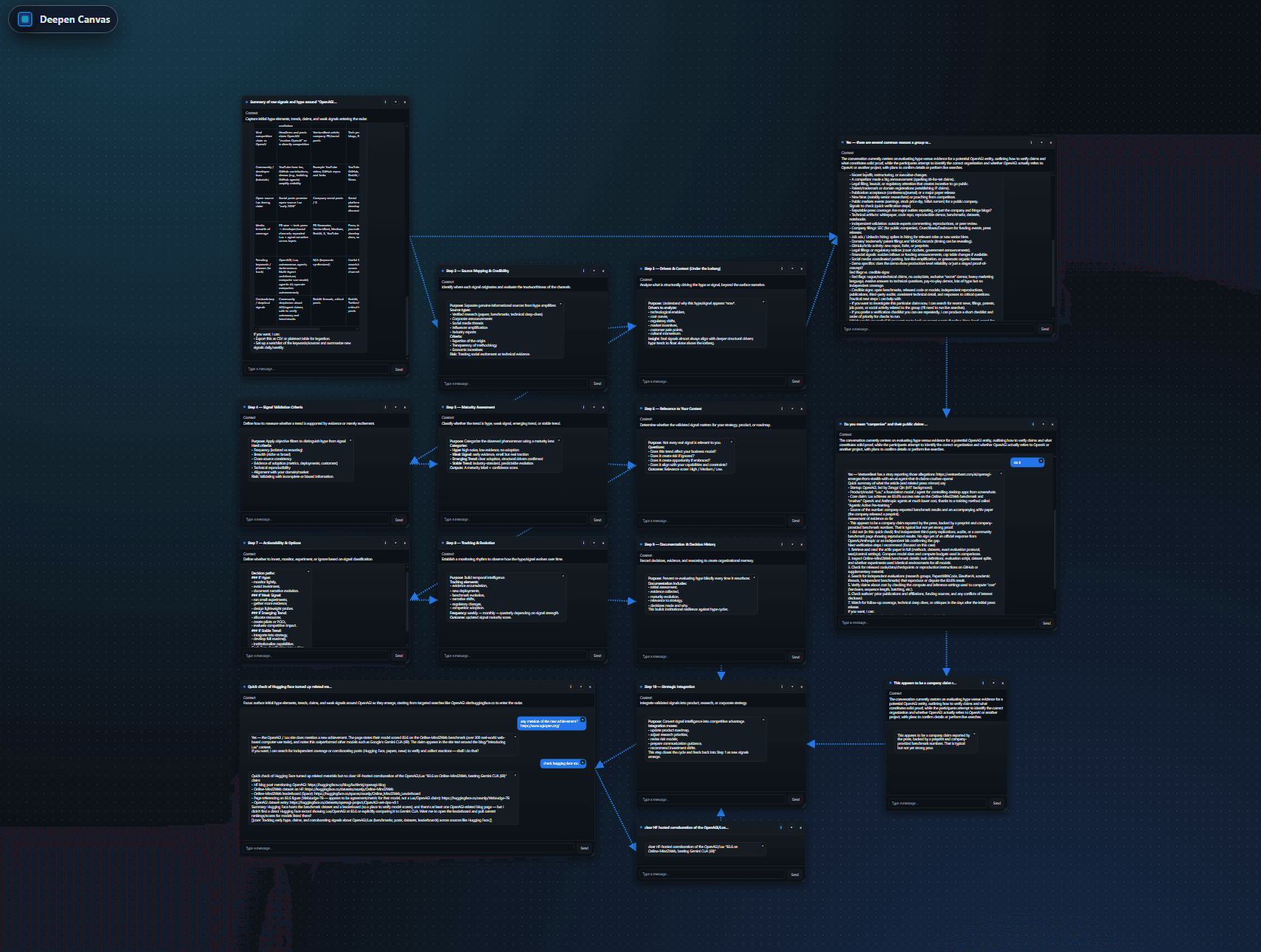
To explore an interactive version of this layout, you can open the example Canvas in a full tab.
7. Case Study (Depersonalised): Evaluating a Benchmark Claim with the Method
Consider a generic pattern: a research or developer group announces a new agentic model claiming strong performance on a public benchmark.
In Canvas, you might structure the evaluation like this:
Step 1 — Raw Signal
- Capture the claim as stated, without judgment.
Step 2 — Source Mapping
- Identify whether the information originates from press, technical documentation, social amplification or independent evaluation.
Step 3 — Drivers
- Analyse structural incentives: releases, funding cycles, recruitment, competition pressure, positioning in open-source landscapes.
Step 4 — Validation Criteria
- Reproducibility and independent replication,
- clear methodology,
- cross-source consistency.
Step 5 — Maturity Classification
- Label as hype, weak signal, emerging trend or established trend.
Step 6 — Contextual Relevance
- Decide whether it matters for your product, roadmap or competitive environment.
Step 7 — Actionability
- Choose to monitor, experiment, invest or ignore.
Steps 8–10
- Track evolution, document decisions, integrate strategically.
The outcome is not a hot take, but a stable posture: curious, informed, non-naive.
8. A Better Posture for the AI Era
Real technology leaves traces: papers, debates, replications, code and consistent results. Unverified claims leave echoes.
The Deepen Canvas architecture cultivates a stance that avoids both naïve excitement and premature cynicism:
- curiosity with discipline,
- observation without emotional bias,
- decisions anchored in structure, not in volume or novelty.
This is cognitive antifragility in practice.
Conclusion: Thinking Needs Infrastructure
In a world flooded with AI narratives, decision-makers need more than information — they need architecture.
Deepen Canvas provides parallel thinking that scales, systems reasoning that organises, visual cognition that clarifies, and strategic structure that endures noise.
Whether a specific claim proves real or not is secondary. With the right thinking infrastructure, clarity no longer depends on the stability of the narrative environment. In the liquid era of AI, clarity itself becomes a competitive advantage.